
Do nothing out of selfish ambition or vain conceit. Rather, in humility value others above yourselves, not looking to your own interests but each of you to the interests of the others. In your relationships with one another, have the same mindset as Christ Jesus. —Philippians 2:3–5
The sun had already ducked behind the Mummy Range and the typical blue and orange tapestry often seen in the western skies of Northern Colorado was beginning to pervade. We were already running behind, and we had a train to catch at 9:00 p.m. Micah, Hannah, and I were supposed to be in Orange City by 4:00 the next afternoon to surprise my dad for his 65th birthday party. My mom had everything planned and I didn’t want to let her down. We would make it, but we didn’t have a lot of time to spare. Suddenly, Hannah heard a slight pop coming from the right, rear tire, and then an explosion that jarred my Ram 1500 to the right curb. We were driving through Greeley and the train station was still 50 miles away in Fort Morgan. I hastily crippled the pickup into a cemetery and we all jumped out to change the tire. If we could perform this task swiftly, there was a chance we could still make it to the train station on time. After fifteen minutes, the spare was on securely and we set off for Fort Morgan. One problem. As is the case with most spare tires, we weren’t supposed to drive faster than 50 miles per hour, but the train was leaving in less than an hour and we had 50 miles to go. I don’t excel in math, but this one was a no-brainer. We had to drive faster than the suggested speed.
“No problem, right?” I said to myself. “That speed is just a suggestion.”
Ignoring the suggestion, I drove 65 miles per hour. After driving on the spare for 20 miles, a second flat tire inevitably disabled our truck once more. All three of us envisioned the train leaving the station without us in it, and my dad wondering why all his children and grandchildren were there for his party except for us. In this desperate situation, I swallowed my pride, and turned to the mother of my children.
Without a second thought, Francie and her husband Jeremy jumped into each of their own vehicles and drove 50 miles on Highway 34 to save the day. Francie let us drive her car to Iowa, we had a tow truck take my pickup back to Greeley, and at 4:00 the next afternoon, all three of us were there to surprise my father for his 65th birthday.
Samson isn’t exactly the easiest character to talk about in Scripture. He was kind of a douche. Even the author of Hebrews glosses over him, “And what more shall I say? I do not have time to tell about Gideon, Barak, Samson and Jephthah, about David and Samuel and the prophets, who through faith conquered kingdoms, administered justice, and gained what was promised; who shut the mouths of lions, quenched the fury of the flames, and escaped the edge of the sword; whose weakness was turned to strength; and who became powerful in battle and routed foreign armies (Heb. 11:32–34). In fact, it takes some time for Samson to even acknowledge his need for God and pray for help. In Judges 15, Samson goes back to his wife to finally consummate his marriage, only to find her married to someone else. This doesn’t bode well for the Philistines. In a very “controlled” rage, Samson catches three hundred foxes, ties them tail-to-tail in pairs, fastens a torch to each pair of tails, lights the torches, and release them into the fields, vineyards, and olive groves to burn them down. Do you know how long it would take to do this? Why not just burn the fields, vineyards, and olive groves yourself? This story is so odd, that it just had to be true. Who does that? The Philistines respond by burning his wife and her father to death, so Samson viciously slaughters them. He then slaughters thousands of men with the jawbone of a donkey. So obviously, he’s thirsty. It isn’t until he’s thirsty and there isn’t any water for him to drink, that he decides to ask God for help. Samson swallows his pride and prays, “You have given your servant this great victory. Must I now die of thirst and fall into the hands of the uncircumcised?” (Judges 15:18).
For Samson, it wasn’t until he had exhausted all his options, that he turned to God for help. His ego couldn’t give way to humility. Even his prayer was a bit on the arrogant side. It is interesting that God immediately answered his prayer and provided for him. God didn’t say, “You’ve managed on your own so far, go find some water yourself.” Samson’s slightest bit or reliance on God with one prayer of desperation results in God’s provision.
For years, I believed everything was going great in my life. I had an awesome family, a fulfilling career, and a beautiful home with a view of the Rockies. Life was good, and I had no need for God to make it complicated. I pursued my own selfish ambitions. Like Samson, I was kind of a douche. Now, when everything is crashing down on me and I’m thirsty, what do I do? I fall to my knees and I ask God to quinch my thirst. In the same way that Francie and Jeremy dropped everything to come to our rescue that evening 20 miles east of Greeley, God will drop everything to come to our rescue when we fall to our knees in humility, swallow our pride, and ask God to save us. God isn’t petty. God doesn’t hold grudges.
In his speech from the White House as part of the American Legion Program, President Dwight D. Eisenhower said, “There are no atheists in foxholes.” My buddy once said that the only time we truly need God in our life is when we truly need God. There’s so much truth in these sayings and it bothers me. Why are we all so compelled to be like Samson—to turn to God only when we need God and to seek out our own selfish ways when things seem to be going well? I hate this about myself. I hate this about human nature.
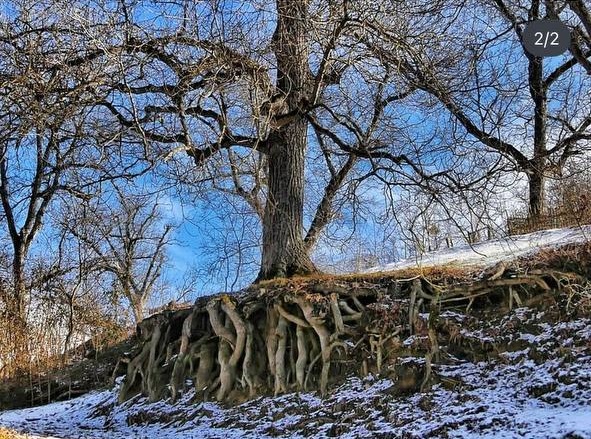
I want to conclude with an analogy and I’m not sure who even came up with it, so unfortunately, I can’t provide an attribution. There are three kinds of people in this world. Leaves, branches, and roots. Leaves are only there for a season. You can’t depend on them. Whenever the wind blows, they blow away. Branches are stronger and maybe last longer, but eventually the weight is too much for them, and they’ll break. Roots hold you up and help you live a healthy life. If you thrive, roots are happy. They don’t attract attention or even want it. Roots hold you up, nourish you, feed you, water you, and keep you strong. Roots love you for who you are, not for what you do or don’t provide them with. God is a root. Francie and Jeremy are roots. My children and my true friends are roots. My dad, my brother, and my sister are roots. I want to be a root. So, my prayer today isn’t for water from God, it is for me to be a root and provide water for someone else.




 shawnvanderlugt